News
Securitize Launches Tokenized US Stocks on Solana

Securitize launched tokenized trading of US stocks on October 8, 2026, starting with Apple, Nvidia, Microsoft and others. The tokens are backed one-to-one by real shares and run on Solana, settling in USDC. Eligible investors in the US and EU get initial access during extended market hours, with 24/7 trading planned.
On Thursday, October 8, Securitize launched blockchain-based trading of tokenized stocks in major listed companies including Apple, Nvidia and Microsoft, according to Reuters. The tokens are backed by underlying shares, and the launch puts one of the oldest promises of the tokenization industry — real equities on a blockchain — into a live, regulated product.
Four days earlier, a joint venture between crypto exchange OKX and NYSE owner Intercontinental Exchange filed with the SEC to build a venue for 24/7 trading of 63 tokenized US stocks — together, the two announcements mark the most aggressive week yet for bringing mainstream equities onto blockchain rails.
What Securitize launched
Securitize”s new offering gives eligible investors in the US, the European Union and other permitted jurisdictions a way to buy blockchain tokens tied to some of the world”s most widely held companies, Reuters reported. The initial lineup includes Apple, Microsoft, Nvidia, Alphabet, Tesla, Meta and Amazon, according to The Block, with SpaceX, Palantir, Circle and Strategy expected later.
The product is deliberately designed to sidestep the most common criticism of tokenized stocks. Many overseas tokenized-equity products track stock prices without giving holders the actual rights of ownership. Securitize”s version is backed one-to-one by real shares held through the regulated brokerage infrastructure of Securitize Markets, and the tokens carry the applicable shareholder rights, dividends and corporate-action entitlements of the underlying stock (The Block). The company calls the instrument a “Convertible Entitlement Token,” or CET, and says the positions are designed so they could migrate into an issuer-sponsored tokenized share structure if a company later chooses to issue one itself.
The launch happens on the Solana blockchain, with settlement in USDC, the dollar-backed stablecoin. Trading will initially be available during extended US market hours, with Securitize planning to expand toward around-the-clock trading. Reuters also reported that Securitize expects its tokens to trade on the NYSE”s forthcoming round-the-clock venue and on a planned trading venue from OKX and ICE (Reuters).
Carlos Domingo, Securitize”s CEO, said the goal was to put “the actual ownership experience onchain — with the underlying shares, shareholder rights, regulated market infrastructure,” rather than merely selling a price that tracks a stock (The Block). Earlier this year the company had brought in trading firms Jump and Jupiter to provide liquidity and access for the effort (The Block).
How the tokens are supposed to work
A tokenized stock is a blockchain token whose value is tied to a share of a listed company. The idea is simple: instead of shares moving only through the traditional plumbing of brokers, clearinghouses and two-day settlement cycles, a token can change hands on a blockchain in minutes and settle almost instantly.
Securitize”s implementation has three notable features worth understanding.
First, the backing is direct: each token corresponds to one real share held through a regulated brokerage — a meaningful distinction from offshore products that use debt notes or derivative contracts to mimic stock prices.
Second, settlement uses USDC. Trades clear in a dollar-denominated stablecoin on Solana rather than through bank wires and batch settlement — a transfer that takes days in the conventional system can be recorded in seconds.
Third, the shareholder rights travel with the token: dividends, stock splits and proxy votes are supposed to flow through to the token holder, just as with a conventional shareholder.
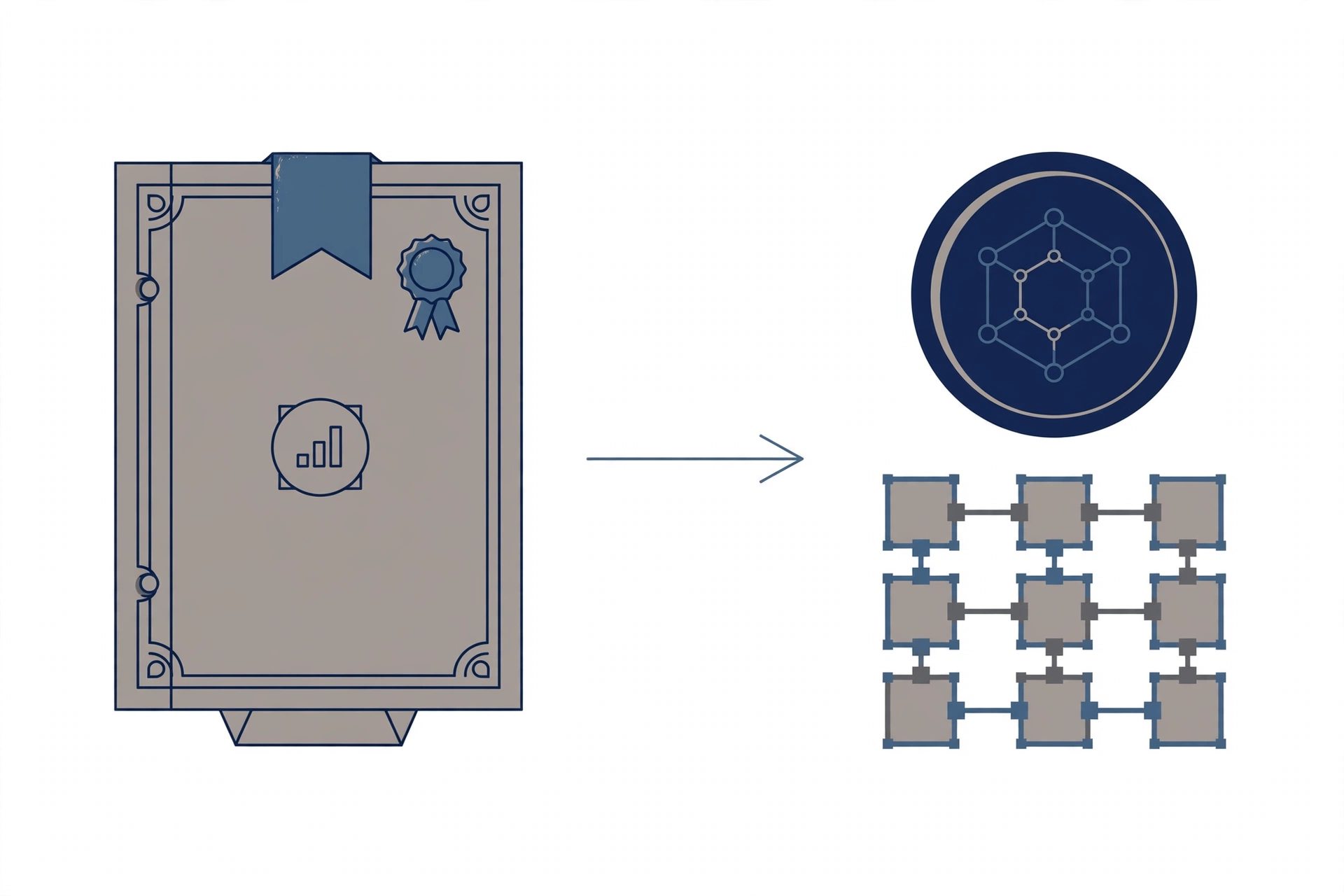
Each token is designed to correspond to one real share held through a regulated brokerage — not a price-tracking derivative.
Why this week matters for tokenization
The launch arrives as tokenized stocks cross $3 billion in onchain value, with Securitize accounting for much of the recent growth (data: The Block/RWA.xyz).
The OKXICE filing four days earlier shows where the industry”s ambitions go next. The 50-50 joint venture between OKX and ICE notified the SEC on October 4 that it intends to run a “Tokenized Securities Venue” for round-the-clock trading of tokenized shares in 63 US-listed companies, including Nvidia, Apple, Microsoft and Tesla. The venue would use permissioned Uniswap v4 liquidity pools on X Layer, OKX”s layer-2 network, with each tokenized stock paired against USDC, USDG or USDT (Unchained).
The filing leans on a regulatory lane that opened on September 17, 2026, when the SEC issued an “Innovation Exemption” giving qualifying tokenized securities venues temporary relief from the Exchange Act”s definition of an exchange (memeburn). Companies named in the notice get 30 days to object — chipmaker Cerebras already has — so the earliest realistic launch is early November (memeburn).
The industry is shifting from “track the price of a stock onchain” to “own a share of stock onchain.” The first model is a derivative; the second is a genuine transfer of equity onto blockchain infrastructure. This week”s two launches are both attempts at the second model.

The OKXICE filing points toward a future where US stocks could trade around the clock on blockchain rails.
The risks, honestly stated
None of this is frictionless, and the compliance-oriented reader should note where the rough edges sit.
Weekend pricing gaps. When tokens trade while the underlying exchange is closed, prices can drift from fair value. A token that trades 24/7 does not have a live underlying price to anchor to on Saturday night, which can create gaps and unusual spreads when regular hours resume.
Eligibility and KYC. These are securities, and Securitize”s product is limited to eligible investors in permitted jurisdictions. Holding the tokens typically means allowlisted wallets and onboarding that looks more like opening a brokerage account than downloading a wallet app. That is a feature of the compliance design, not a bug — but it means the “anyone can trade anything” pitch does not apply here.
Counterparty and smart-contract risk. The token is only as good as the structure behind it: the broker holding the shares, the legal claim it confers, and the code that moves it. Many tokenized products sold outside the US carry weaker rights and disclosures than real equities (Reuters). Automated-market-maker venues, as OKXICE proposes, concentrate risk in the smart contracts.
Regulatory ceilings. The SEC”s innovation exemption is a temporary experiment, not a permanent rule. The whole category could shrink or change shape depending on how regulators respond after the exemption period, which is exactly the kind of uncertainty institutional capital tends to wait out.
What to watch next
What decides whether this week”s launches are a milestone or a moment is volume after the first few weeks, and the OKXICE decision in November: whether the SEC lets the 24/7 venue proceed — and whether companies opt out — will define how far the 1:1-backed model can go in the US.
Real shares, real dividends, on a blockchain — the industry has been promising this for years, and this week it started to ship.
FAQ
What did Securitize launch on October 8, 2026?
Blockchain-based tokens tied to US stocks, initially covering Apple, Microsoft, Nvidia, Alphabet, Tesla, Meta and Amazon, running on the Solana blockchain with settlement in USDC. Each token is backed one-to-one by an actual share held through Securitize Markets” regulated brokerage infrastructure (Reuters, The Block).
What rights does a Securitize tokenized stock carry?
The tokens are designed to carry the shareholder rights of the underlying shares, including applicable dividends and corporate-action entitlements. Securitize calls the instrument a “Convertible Entitlement Token” (CET), structured so it could transition into an issuer-sponsored tokenized share if a company later adopts that model (The Block).
Who can buy them, and when can they trade?
Securitize says the products are available to eligible investors in the US, the EU and other permitted jurisdictions, initially during extended US market hours with plans to move toward 24/7 availability (Reuters).
What is the OKXICE filing, and how is it different?
OKXICE — a joint venture of OKX and ICE — notified the SEC on October 4 of plans to run a “Tokenized Securities Venue” under the SEC”s new innovation exemption, for 24/7 trading of 63 tokenized US stocks in permissioned Uniswap v4 pools on OKX”s X Layer (CoinDesk, Unchained). Unlike Securitize”s broker-dealer launch, it relies on a temporary SEC exemption and automated market makers rather than an order book.
What are the main risks of tokenized stocks?
Weekend pricing gaps when the underlying exchange is closed, strict eligibility and KYC requirements, counterparty and smart-contract risk in the token structures, and regulatory uncertainty since the SEC”s innovation exemption is a temporary experiment (Reuters, memeburn).
Sources
- Securitize launched blockchain-based trading of tokenized stocks (www.reuters.com)
- a joint venture between crypto exchange OKX and NYSE owner Intercontinental Exchange filed with the SEC (www.reuters.com)
- according to The Block (www.theblock.co)
- notified the SEC on October 4 (www.coindesk.com)
- Unchained (unchainedcrypto.com)
- memeburn (memeburn.com)
- CoinDesk (www.coindesk.com)