News
The $300B Stablecoin Market Belongs to Two Issuers

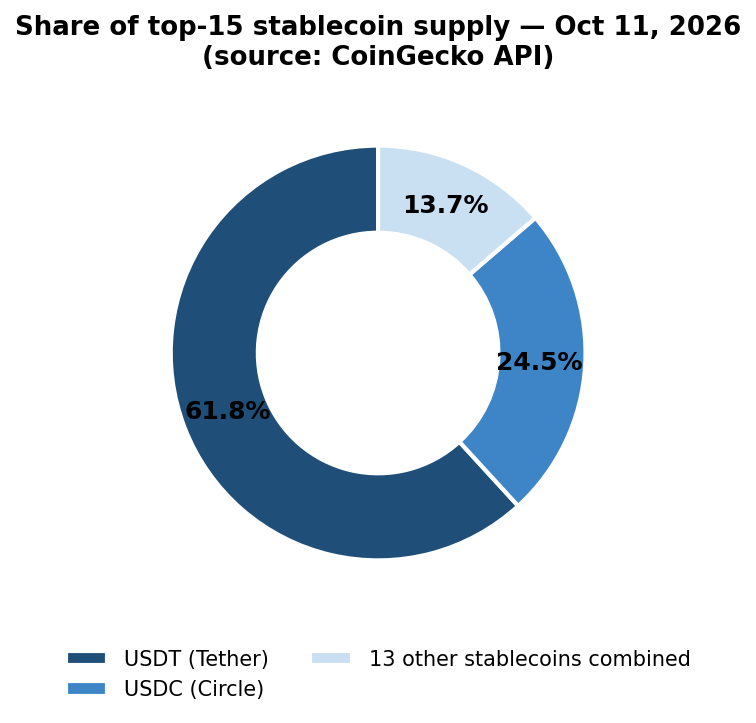
The short version: Tether’s USDT and Circle’s USDC control roughly 86% of the top-15 stablecoin supply — about $257 billion out of $298 billion, based on CoinGecko market-cap data pulled on October 11, 2026. And the regulators are moving: this week the EU’s securities watchdog gave crypto platforms three months to cut ties with non-compliant tokens like USDT, while Washington is still writing the rulebook for its own stablecoin law.
Stablecoins are supposed to be crypto’s boring money — the dollars you park between trades. But the market for them is anything but boring right now. It’s a two-company business wearing a fifteen-company costume, and the costumes are about to come off. What happens next won’t be decided by traders. It’ll be decided in Brussels and Washington.
The two-coin market
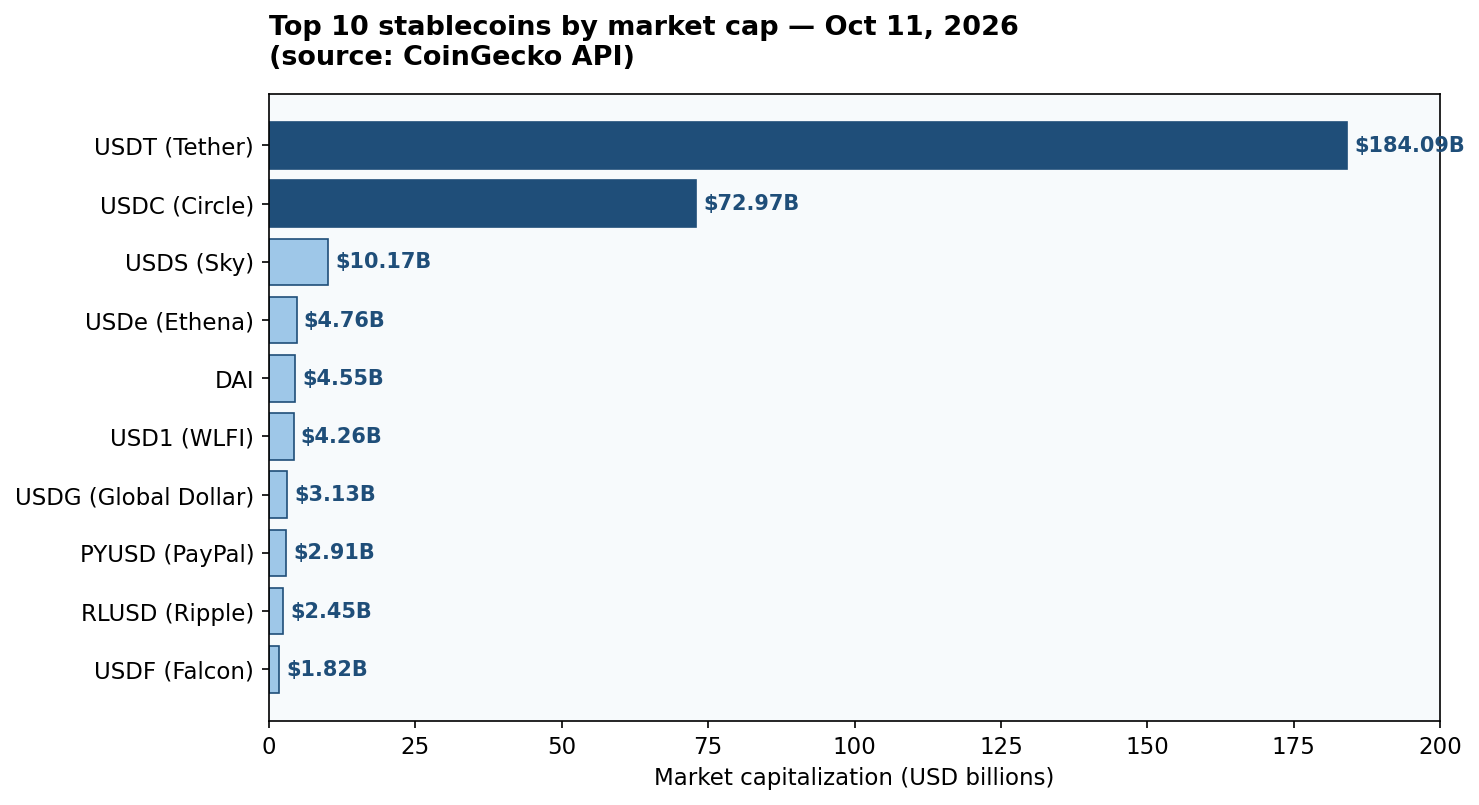
Pull the top 15 stablecoins by market cap and the concentration is hard to unsee:
| Rank | Stablecoin | Market cap | Share |
|---|---|---|---|
| 1 | USDT (Tether) | $184.09B | 61.8% |
| 2 | USDC (Circle) | $72.97B | 24.5% |
| 3 | USDS (Sky, formerly MakerDAO) | $10.17B | 3.4% |
| 4 | USDe (Ethena) | $4.76B | 1.6% |
| 5 | DAI | $4.55B | 1.5% |
| 6 | USD1 | $4.26B | 1.4% |
| 7 | USDG (Global Dollar) | $3.13B | 1.1% |
| 8 | PYUSD (PayPal) | $2.91B | 1.0% |
| 9 | RLUSD (Ripple) | $2.45B | 0.8% |
| 10 | USDF (Falcon Finance) | $1.82B | 0.6% |
Table: compiled by BlockPayCoin from CoinGecko stablecoins category data, October 11, 2026. Top 15 total: $297.65B.
USDT and USDC together are 86.3% of that total. Add third-place USDS and you’re at nearly 90%. The other twelve combined? A rounding error next to Tether alone.
For scale: the whole stablecoin pile — around $298 billion — is about 10.6% of the total crypto market cap of $2.81 trillion (CoinGecko global data, same day). So stablecoins are a meaningful slice of crypto. And almost all of that slice is two logos.
Why nobody can catch them
It’s not that challengers haven’t tried. PayPal launched PYUSD in August 2023 with the obvious pitch: it sits inside one of the world’s largest payment apps, with access to hundreds of millions of consumer accounts (holder.io). Ripple launched RLUSD in December 2024 under a New York banking regulator’s charter, aimed at payments companies (Coinspeaker). MakerDAO rebranded to Sky and rolled out USDS in September 2024 (CoinDesk). Ethena built USDe, a synthetic dollar backed by crypto hedges (BlockEden).
None of it has dented the top two. Why? Two reasons, and they reinforce each other.
First, liquidity is the product. A stablecoin’s job is to be there — tradeable instantly, at par, against everything. USDT has a decade of being the quote currency on nearly every crypto exchange on earth. Every listing, every market-maker feed, every arbitrage bot defaults to it. Switching costs are real: traders don’t leave the deepest order books for a marginally better-designed token.
Second, trust compounds. USDC grew by doing the opposite of Tether’s playbook — courting regulators and institutions instead of skirting them. When companies, banks, and funds needed a compliant dollar token, USDC was the one with the paperwork. The moat isn’t the code. It’s the relationships.
Brussels draws the line
And here’s where it gets interesting. The duopoly doesn’t get to keep operating on its own terms anymore. Europe already decided that.
On October 8, the European Securities and Markets Authority (ESMA) told EU crypto platforms they have three months to end customer exposure to stablecoins that don’t comply with MiCA, the EU’s crypto rulebook — with national regulators instructed to have remaining holdings resolved by January 8, 2027 (CoinDesk). The guidance doesn’t name tokens. It doesn’t have to: USDT and PYUSD are the prominent non-authorized examples cited by the reporting, and platforms from Coinbase to Bitstamp already began restricting USDT for EU users back in late 2024 and early 2025.

MiCA’s stablecoin rules have applied since June 30, 2024 (thecrypto.wiki). In short: issue a dollar token to Europeans and you need an EU license, 1:1 reserves in segregated accounts, and redemption at par on demand. For issuers deemed significant, 60% of reserves must sit as deposits in EU banks.
Circle played along — it secured a French electronic money institution license in July 2024, keeping USDC (and EURC) available across the bloc. Tether didn’t. The company pointed at that 60% bank-deposit rule as fundamentally incompatible with how it manages reserves, and walked away from EU authorization instead.
So the market is splitting in two. In Europe, USDC is the compliant incumbent. Globally, USDT is still the biggest token in crypto. The question ESMA’s deadline sharpens: how long can one token be effectively banned in a major economy while dominating everywhere else?
Washington is still writing
Across the Atlantic, the US finally has a stablecoin law — the GENIUS Act, signed by President Trump on July 18, 2025, the first comprehensive federal statute for payment stablecoins (Crypto Times). It requires issuers to be licensed, to back tokens 1:1 with high-quality liquid reserves, and to disclose those reserves monthly.
But a law is just the frame. The actual rules — capital requirements, risk management, reserve composition — are being written by the banking regulators. And they’re behind schedule: agencies missed a rule-making deadline in July 2026, a year after signing. In late September, the Federal Reserve put out its own proposals — full reserve backing including short-term Treasuries, standardized capital rules, and an application path for banks that want to issue stablecoins — and opened a 60-day public comment period (TradingView/Cointelegraph).
The GENIUS Act takes effect on the earlier of January 18, 2027 or 120 days after regulators finalize their rules (Crypto Times). Either way, 2027 is shaping up as the year stablecoins stop being the Wild West’s reserve currency and start being regulated money.
The challengers’ real problem
Look at the table again. The combined market cap of challengers three through fifteen is about $40 billion — less than a quarter of USDT’s. Some of them have genuinely different designs: USDS pays rewards through Sky’s savings rate, USDe generates yield from hedged crypto positions, USDG was built by a consortium specifically to share reserve income with distributors.
But the duopoly’s edge isn’t design. It’s distribution and compliance status — and both are getting harder to replicate. MiCA turned European distribution into a licensing moat for Circle. GENIUS is about to turn US distribution into one for whoever clears its bar first. The challengers aren’t really fighting Tether and Circle anymore. They’re fighting the paperwork.
That’s the analysis worth sitting with. Stablecoins didn’t become an 86%-two-company market because the technology favors monopolies. They became one because money is the ultimate network-effects business — and now, because regulators are handing out moats to whoever filed first.
FAQ
How concentrated is the stablecoin market?
Very. Tether’s USDT ($184.09B) and Circle’s USDC ($72.97B) held 61.8% and 24.5% of the top-15 stablecoin market cap respectively as of October 11, 2026 — 86.3% combined, per CoinGecko category data.
Why is USDT being restricted in Europe?
Tether did not obtain MiCA authorization. The EU’s Markets in Crypto-Assets regulation requires stablecoin issuers serving Europeans to hold an EU license and keep reserves (including a 60% bank-deposit share for significant issuers) in EU institutions. Tether publicly objected to that reserve-composition rule and did not apply.
What did ESMA announce in October 2026?
On October 8, 2026, ESMA issued guidance giving EU crypto platforms three months to wind down customer exposure to non-MiCA-compliant stablecoins, with remaining holdings to be resolved by January 8, 2027.
What is the US GENIUS Act?
The Guiding and Establishing National Innovation for U.S. Stablecoins Act, signed July 18, 2025. It’s the first comprehensive US federal framework for payment stablecoins, requiring licensed issuance, 1:1 high-quality reserve backing, and monthly disclosures. Implementing rules are still being written by banking regulators.
Do challengers like PYUSD or RLUSD stand a chance?
The numbers say the gap is enormous: PYUSD ($2.91B) and RLUSD ($2.45B) are each about 1% of the top-15 supply. Both lean on regulated credentials and established payment networks rather than trying to out-liquidate the incumbents. Whether that strategy closes an 86-point gap remains to be seen.
Sources
- CoinGecko market-cap data (www.coingecko.com)
- holder.io (holder.io)
- Coinspeaker (www.coinspeaker.com)
- CoinDesk (www.coindesk.com)
- BlockEden (blockeden.xyz)
- CoinDesk (www.coindesk.com)
- thecrypto.wiki (www.thecrypto.wiki)
- Crypto Times (www.cryptotimes.io)
- TradingView/Cointelegraph (www.tradingview.com)