Learn
How a Blockchain Works: Blocks, Hashes and the Chain
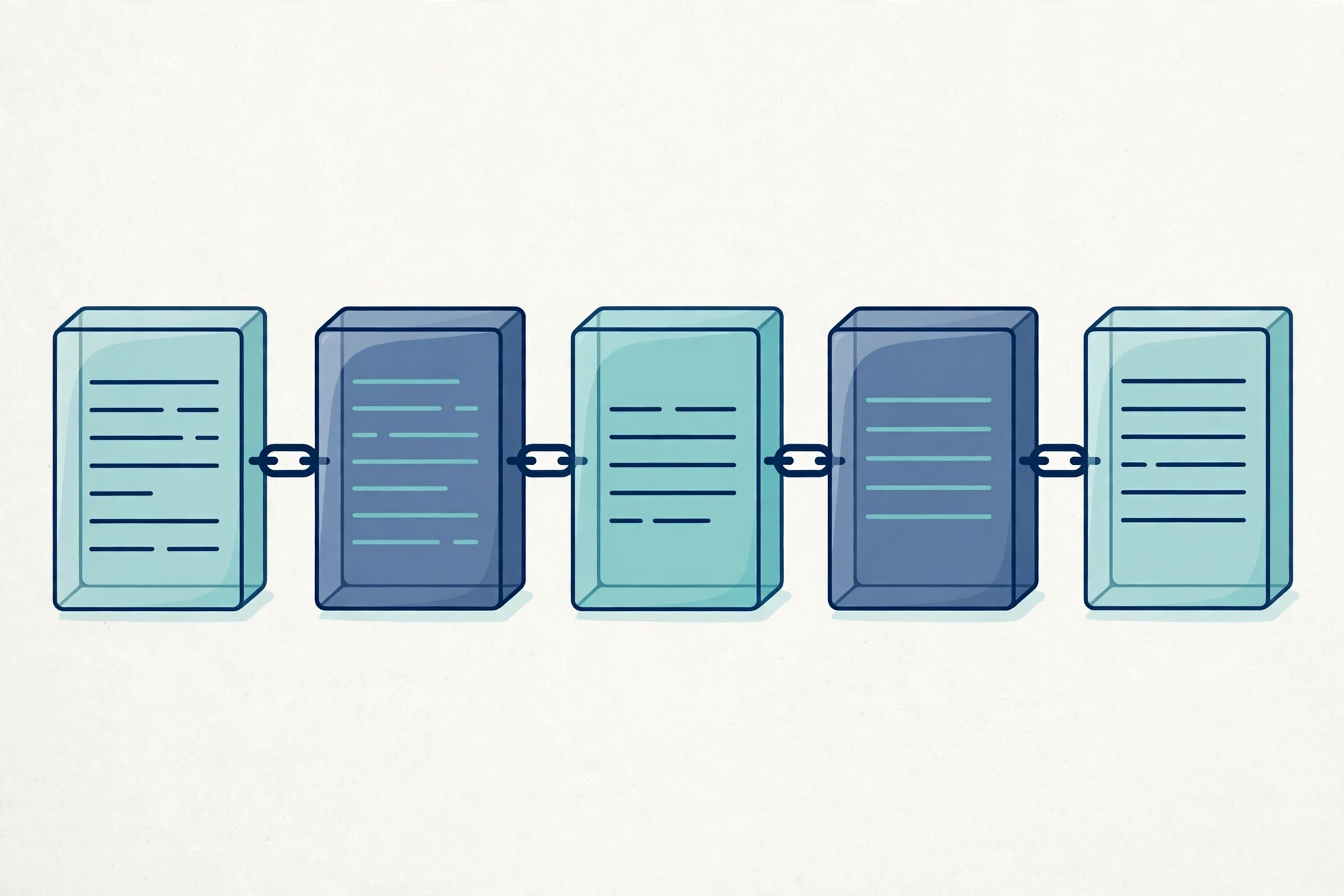
The short version: A blockchain works by grouping new records into a block, sealing that block with a digital fingerprint called a hash, and writing the previous block’s fingerprint inside the next one. Change anything in an old block and its fingerprint changes too, so the chain no longer lines up and other computers can spot the break.
If you have read our pillar guide, What Is a Blockchain? A Beginner’s Guide, you already have the picture: a shared book, copied in many places. This piece slows down and looks at the machinery. How does a record actually get in? What is inside a block? And why does linking blocks together make quiet edits so hard?
No maths degree needed. Just follow one transaction from the moment someone sends it to the moment it becomes part of the permanent record.
How does a blockchain work, step by step?
A transaction starts as a signed message broadcast to the network, waits in a pool of pending records, gets checked by nodes, and is then bundled with other transactions into a block. Once the network accepts that block through its consensus process, every node adds the same block to its copy and the records inside are treated as confirmed.
Here is that path in order:
- Someone creates a transaction. A wallet signs a message with a private key. The signature proves who authorised it without sharing the key itself.
- The message spreads. The wallet sends it to nearby nodes, and they pass it on. Within seconds, computers around the world have heard about it.
- Nodes check it. Each node runs the same rules. Does the signature match? Does the sender actually have the funds? A record that fails gets dropped, not debated.
- Valid transactions wait together. They sit in a pending pool, sometimes called a mempool on Bitcoin, until a block maker picks them up.
- A block is proposed. One participant, chosen under the network’s consensus rules, bundles a set of transactions, adds a header, and broadcasts the block.
- The network accepts or rejects it. Other nodes re-check everything. If the block follows the rules, they append it. If it doesn’t, they ignore it and keep waiting for a valid one.
On Bitcoin, a new block arrives roughly every 10 minutes, a target the protocol keeps by adjusting difficulty, as the Bitcoin developer guide explains. Ethereum is much faster, at about 12 seconds per block, according to ethereum.org’s block documentation. Speeds differ. The sequence — propose, check, append — doesn’t.
What is actually inside a block?
Think of a block as a page with a label stuck on top. The page holds the records. The label — the block header — holds the information other computers need to verify the page and place it in the right spot.
The exact fields vary by network, but you will usually find the same kinds of items:
| Part of a block | What it does |
|---|---|
| Transactions | The actual records: who sent what, which program ran, which state changed. |
| Previous block hash | The fingerprint of the block before this one. This is the link that makes it a chain. |
| Timestamp | When the block maker says the block was created, checked against network rules. |
| Merkle root | A single fingerprint that summarises all the transactions in the block, so a change to any one of them changes the summary. |
| Consensus data | The extra fields a network needs for its agreement method — for example, the nonce in proof of work or validator information in proof of stake. |
That header design matters more than it first looks. A node doesn’t have to re-read every old transaction to check where a block belongs. It can read the header, confirm the previous hash matches, and know the block claims the right place in line. Light clients on phones rely on exactly that shortcut.
Satoshi Nakamoto described this structure in the original Bitcoin whitepaper, where transactions are hashed into an ongoing chain and each timestamp reinforces the ones before it. The wording is from 2008. The layout still describes what you see on Bitcoin today.
What is a hash, and why does it seal a block?
A hash is a fixed-length fingerprint produced by running data through a one-way function. Feed in a block and you get a short string of characters out. Feed in the same block again and you get the same string every time, but change even one character in the block and the output looks completely different — and you can’t work backwards from the fingerprint to rebuild the original.
That one property does a lot of quiet work, so let’s make it concrete.
Say a block contains a record that reads “A pays B 2 coins.” Its hash might be a string starting with a91f. Now someone edits the record to “A pays B 20 coins.” The new hash won’t be close to the old one. It will look random and unrelated. There’s no small drift to hide in.
Nodes exploit that. When a block arrives, they hash it themselves and compare the result with what the header claims. A mismatch means tampering or corruption, and the block gets rejected without argument. You don’t need to trust the sender. You can redo the sum.
We kept this section short on cryptography on purpose. If you want signatures, public keys and hashing in one place, our guide to how cryptography secures data covers that ground in plain language and shows where hashes sit in the bigger toolkit.

Why can’t you just rewrite an old block?
You can’t quietly rewrite an old block because the next block stores its hash. Edit the old block and its hash changes, so the hash recorded in the following block no longer matches. To hide the edit you would have to rebuild every block after it and then convince the rest of the network to accept your longer, rewritten version instead of theirs.
Walk it through. Block 100 holds a payment. Block 101 holds block 100’s hash. Block 102 holds block 101’s hash, and so on to the present day.
Edit block 100 and you break block 101. Fix block 101 by inserting the new hash and block 101’s own hash changes, which breaks block 102. The damage runs forward, block after block, like a tear that keeps opening ahead of your needle.
And stitching isn’t free. On a proof-of-work chain you would have to redo the work for each rebuilt block, faster than the honest network is adding new ones. On a proof-of-stake chain you would need control of enough staked assets to get your version accepted. In both cases the cost rises as the block gets older and more blocks pile on top of it. A recent record has fewer confirmations and is easier to displace. An old record is buried under a mountain of later work.
That’s the honest way to phrase it: tamper-evident and expensive to rewrite, not magically impossible. Small or poorly secured networks have had their histories rewritten. Large public networks make the price so high that nobody has treated it as a practical option.
Who does the checking if there’s no central office?
Nodes do. A node is just a computer running the network’s software, holding a copy of the chain, and enforcing the rules on everything it sees. Nobody appoints them. Anyone can run one, and a node that starts approving bad blocks simply gets ignored by the others.
But nodes on their own don’t decide who writes the next block. That job falls to consensus — the process a network uses to pick a block proposer and get everyone to settle on one version.
You don’t need the full comparison here. Just hold the shape: proof of work picks the proposer through a costly computing race, and proof of stake picks from validators who have locked up a deposit. We compare cost, security and energy side by side in Proof of Work vs Proof of Stake.
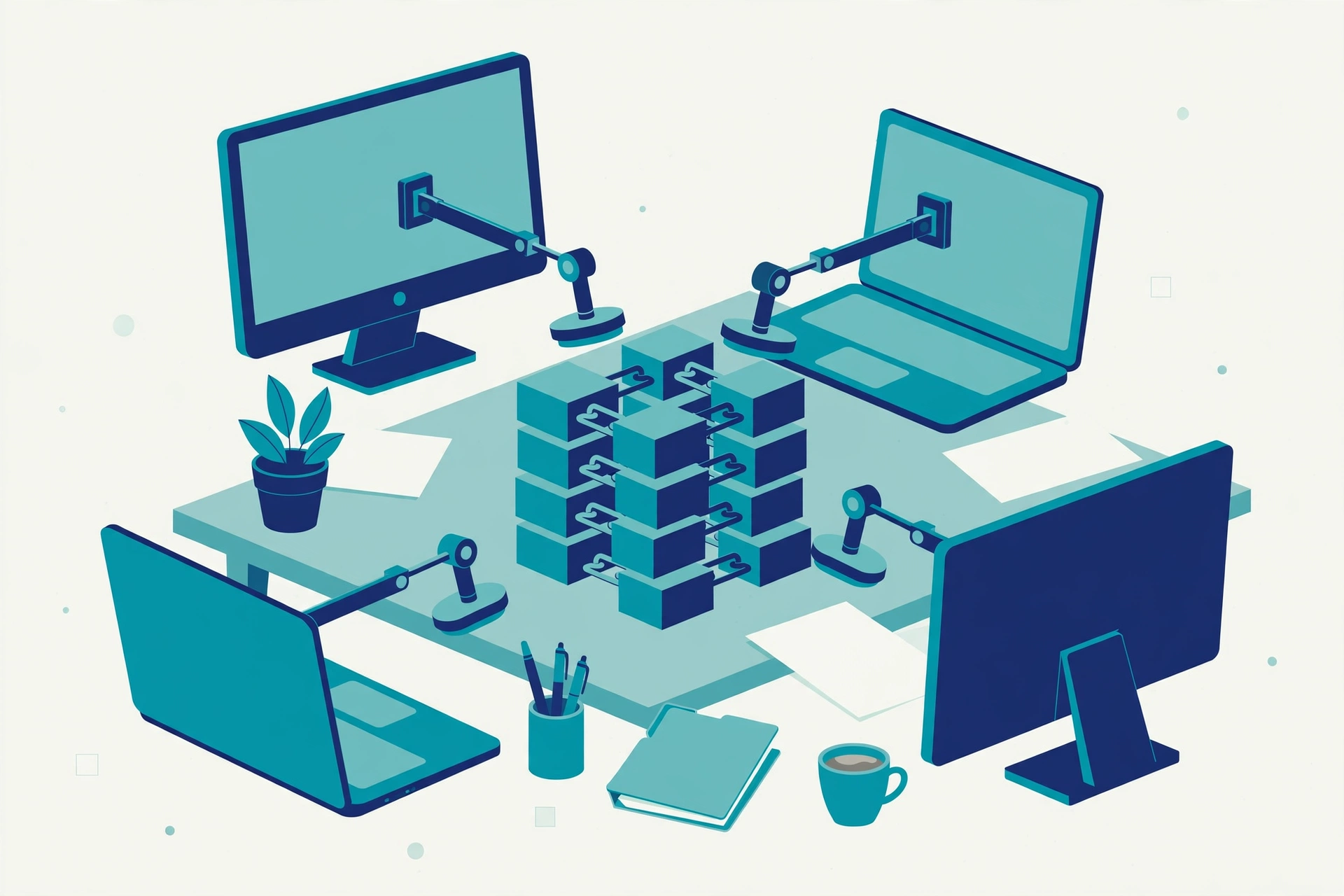
One detail people miss: checking is cheap, even when proposing isn’t. Your own node can verify a whole block in a fraction of a second. That asymmetry is deliberate. If verification were expensive, only big operators could afford to check, and everyone else would have to take their word for it. Cheap checks keep the system honest without asking for trust.
So the chain isn’t one clever trick. It’s three ordinary ideas stacked: bundle records together, fingerprint each bundle, and let thousands of independent computers keep copies and refuse anything that doesn’t line up. Remove any one of the three and the thing falls apart. Keep all three, and you get a record that no single participant controls — and that anyone can audit, block by block, right back to the first one.
Frequently asked questions
How does a blockchain work in simple terms?
New records are grouped into a block. That block gets a digital fingerprint and is linked to the block before it. Copies of the whole chain sit on many computers, which check each new block against the same rules before adding it.
What is a block in a blockchain?
A block is a batch of transactions plus a header. The header contains the previous block’s fingerprint, a timestamp and a summary of the transactions inside, so other computers can verify the block and place it in order.
What does a hash do in a blockchain?
A hash turns a block’s contents into a fixed fingerprint. Any change to the block produces a completely different fingerprint, so tampering is easy to spot. The next block storing that fingerprint is what links the chain together.
Can an old blockchain block be changed?
Not quietly on a large public network. Changing an old block changes its fingerprint and breaks every link after it. Rebuilding those links costs more as the block ages, and other computers still hold the original version.
This article was created with AI assistance and reviewed by our editorial team before publishing.
Sources
- Bitcoin developer guide (developer.bitcoin.org)
- ethereum.org's block documentation (ethereum.org)
- Bitcoin whitepaper (bitcoin.org)