Learn
Blockchain vs Bitcoin: What’s the Difference?
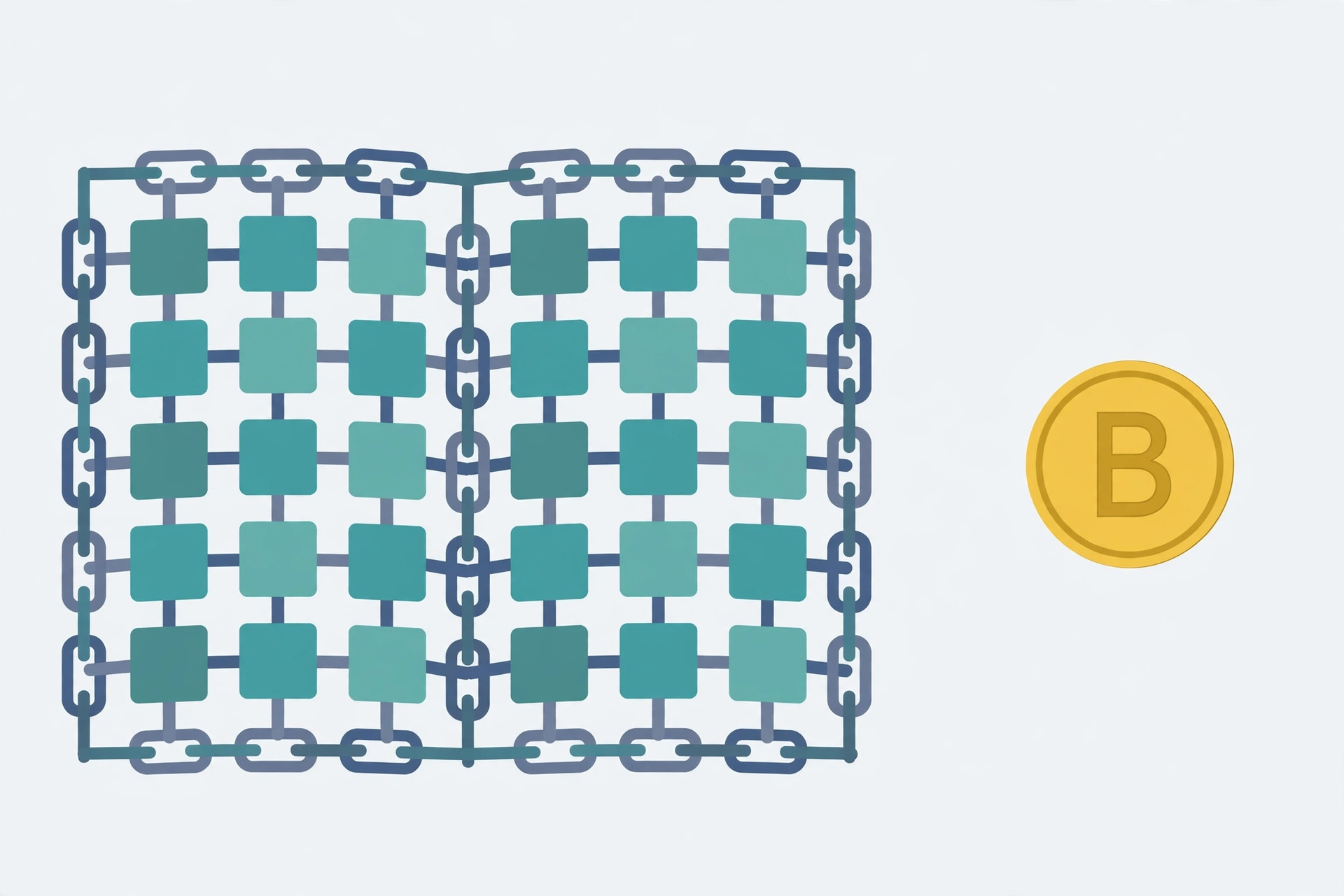
The short version: A blockchain is the record system — a shared list of entries grouped into blocks and linked in order. Bitcoin is one network that uses that system, plus the coin that moves on it. Same family. Different jobs. If you keep those two jobs apart, most headlines get easier to read.
People use the two words as if they were twins. They aren’t. One names a method. The other names a specific project that put the method to work first and made it famous.
If you’re starting from zero, read our pillar guide to what a blockchain is first, then come back here. This page does a narrower job. It pulls the two terms apart, side by side, so you can tell which one a sentence is actually about.
Is Bitcoin a blockchain?
No. Bitcoin is a network and an asset that runs on a blockchain. The blockchain is the underlying record — the shared ledger that lists every transfer. Bitcoin, written with a capital B for the network and a lower-case b for the coin, is the system and currency built on top of that record.
Think of it like email and Gmail. Email is the method for sending messages. Gmail is one service that uses it. You wouldn’t say Gmail is email itself, even though Gmail made email feel normal for a lot of people. Bitcoin did the same for blockchains. It was the first large, public proof that the method could work without a central office keeping the books.
The link starts with a short paper. The Bitcoin whitepaper, published in 2008, set out a peer-to-peer electronic cash system built on a chain of blocks. The paper describes the coin through a chain of digital signatures and the shared history through blocks linked by hashes. In other words, the document itself keeps the two layers separate: the record structure underneath, and the cash system that relies on it.
What is a blockchain, if you leave Bitcoin out of the sentence?
A blockchain is a list of records held by many computers at once, where new records are added in batches called blocks and each batch points back to the one before it. No single computer owns the list. Every participant checks new entries against the same rules, and a mismatch stands out because the copies no longer agree.
That’s it. No coin in that definition. No price. No trading.
Three parts do the work, and each one is plain once you see it:
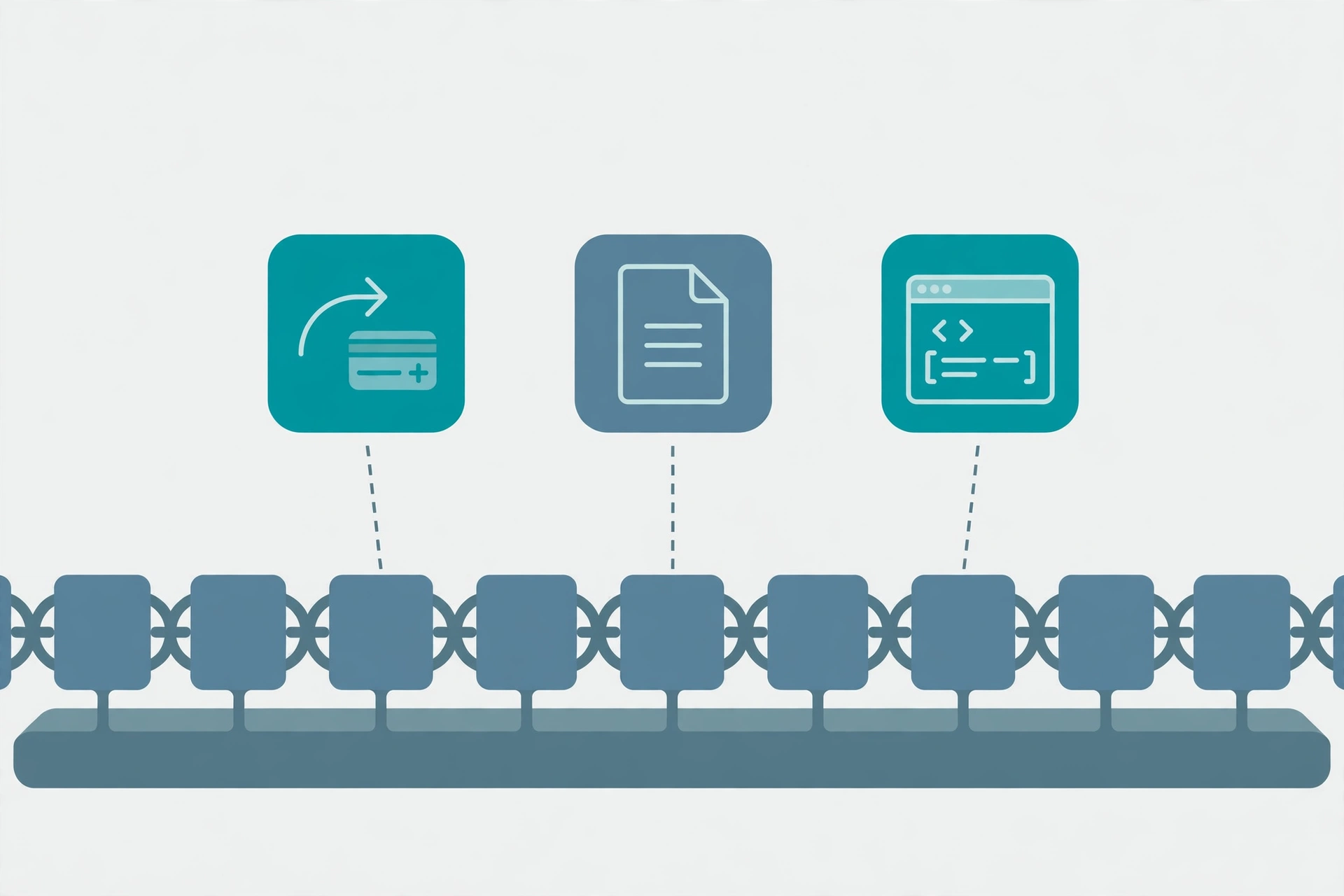
- Blocks. Records don’t arrive one at a time. They’re gathered into a batch, and that batch becomes a block with a timestamp and a summary of what’s inside.
- Links. Each block stores a fingerprint, called a hash, of the block before it. Change an old entry and its fingerprint changes, so the link to the next block breaks.
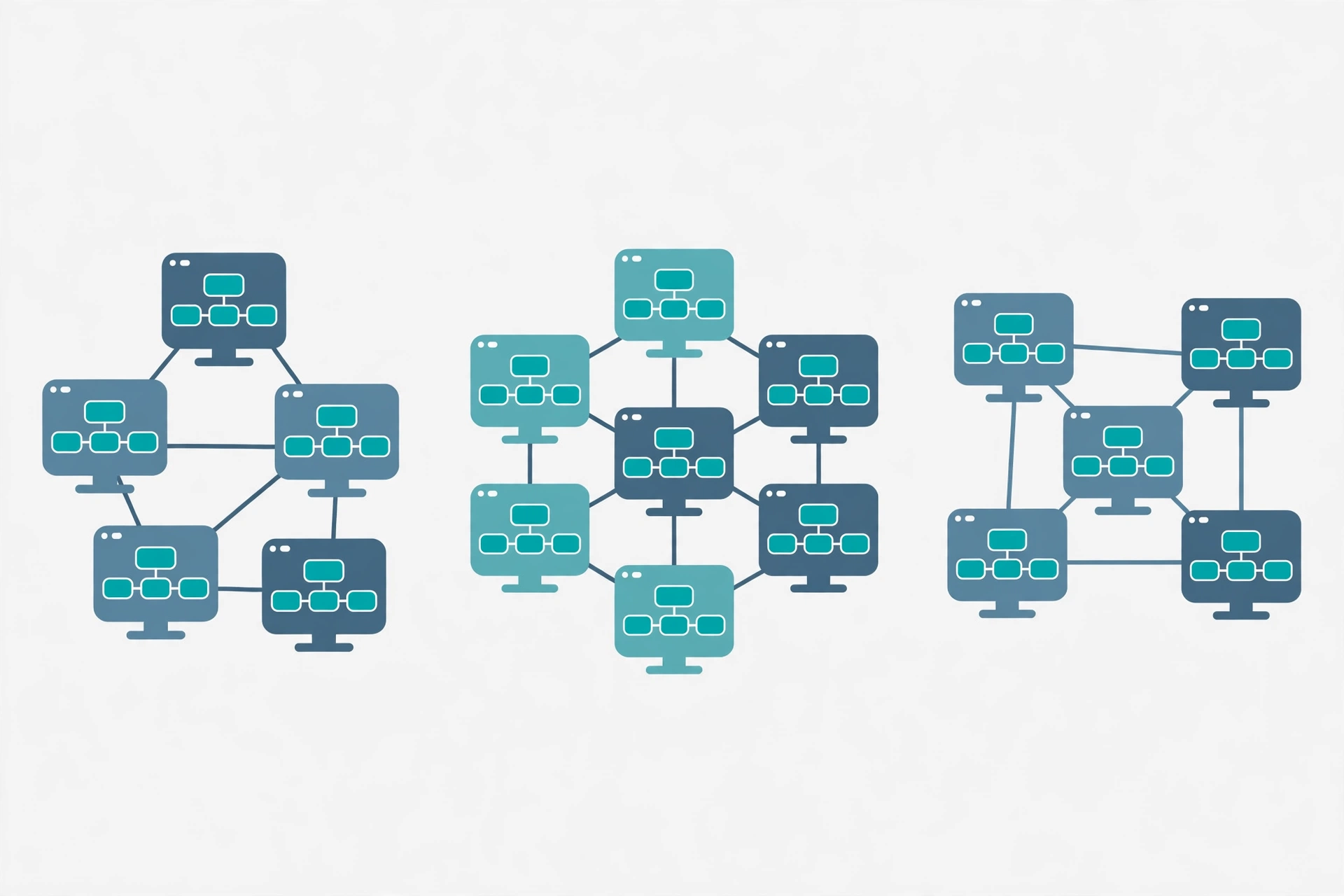
- Copies. Many independent computers, called nodes, hold the same list and add the same new blocks. There’s no headquarters copy to edit in secret.
Want the step-by-step version? Our walk-through of how a blockchain works follows one block from broadcast to acceptance. For this page, you just need the shape: batch, link, copy.
What is Bitcoin, if you leave blockchain out of the sentence?
Bitcoin is a specific network with its own rules, its own participants and its own unit of account, called bitcoin. People broadcast transfers, nodes check them, and the network adds them to its chain in blocks roughly every ten minutes, a target the protocol adjusts on its own, as the Bitcoin developer guide explains. The coin is how the network pays the people who do the work of adding blocks, and it’s the thing being moved in each transfer.
So Bitcoin answers questions a blockchain on its own can’t answer. Which rules? Bitcoin’s rules. Which coin moves? Bitcoin. Which history counts? The history that Bitcoin nodes accept. A blockchain as a general idea has no coin, no ten-minute rhythm and no single history. It only becomes specific when a network adopts it and fills in those choices.
Bitcoin’s own beginner material draws the line the same way. As bitcoin.org’s how-it-works page puts it, the block chain is “a shared public ledger on which the entire Bitcoin network relies.” Read that sentence slowly. The ledger supports the network. The network isn’t the ledger. One sits underneath the other.
| Question | Blockchain | Bitcoin |
|---|---|---|
| What kind of thing is it? | A record-keeping method | One network, plus its coin |
| Does it have a coin? | Not by itself — some chains have one, some don’t | Yes — bitcoin is its unit of account |
| Who sets the rules? | Each network that uses the method sets its own | Bitcoin’s protocol and the nodes that run it |
| Can it exist without the other? | Yes — other networks and private systems use blockchains with no bitcoin involved | No — Bitcoin’s transfers are recorded on its blockchain |
| What do you check to verify it? | The chain’s blocks, links and copies | Bitcoin’s chain, read through a Bitcoin node or explorer |
One method, many networks
Here’s where the split pays off. Once you see the blockchain as a method, you stop expecting every use of it to look like Bitcoin.
Ethereum is the clearest second example. It uses a blockchain too, but it was built to run programs, not just to move a coin. Ethereum’s own developer introduction calls it “a blockchain with a computer inside,” and its smart contracts page describes programs stored on the chain that run when set conditions are met. Same family of record-keeping. Different job on top.
Private systems push the point further. Companies can run a shared chain among themselves to track shipments or certificates, with no public coin at all. The blocks and links are still there. Bitcoin is nowhere in the room.
What “Bitcoin uses a blockchain” does not mean
Short sentences hide a lot. That one is true, but it gets stretched in ways that mislead. Three stretches show up again and again.
It doesn’t mean every blockchain is Bitcoin. A new network can use blocks and hashes and still have nothing to do with Bitcoin — different rules, different coin or no coin, different history. Sharing a method isn’t sharing an identity. Cars share engines. That doesn’t make every car the same model.
It doesn’t mean Bitcoin owns the method. No company or foundation owns the idea of a linked, shared ledger. Bitcoin’s software is open for anyone to read, and other projects took the same building blocks in different directions. You’ll see that in the table above: the method row keeps saying “each network decides,” because no single network gets to decide for the rest.
It doesn’t mean a blockchain record proves a claim is true. A chain proves an entry hasn’t been quietly changed after it was written. It can’t prove the entry was accurate when it went in. If someone writes a false shipment date to a chain, the chain will preserve that false date very reliably. Faithful storage and true content are two different promises, and only the first one is on offer.
A quick test you can run on any headline
Next time a headline mixes the two words, run this three-step check. It takes about ten seconds.
- Swap the word “blockchain” for “shared record system.” Does the sentence still make sense? If yes, the writer meant the method.
- Swap the word “Bitcoin” for “one network and its coin.” Does it still make sense? If yes, the writer meant the specific project.
- If neither swap works, the sentence is probably trading on the blur between the two. Read the rest with care, and check what the source actually links to.
Try it on “blockchain payments are growing.” Step one gives you “shared record system payments” — clumsy, but it points at the method in general. “Bitcoin payments” names one network instead. The two headlines look alike. They aren’t reporting the same fact.
Why the confusion sticks around
Honest answer? History. For years, the only blockchain most people heard of was Bitcoin’s, because it was the first one running in public at any real scale. News stories shortened “Bitcoin’s blockchain” to “the blockchain,” and the two names started trading places in casual speech.
You don’t need to police anyone’s language. You just need to catch it in your own reading. When a claim sounds big — a whole technology rising or falling on one coin’s week — ask which layer the evidence is really about. Is it about the method, which many networks share and which no single failure can switch off? Or is it about one network, with its own rules and its own history? Most muddled crypto arguments clear up the moment you answer that one question.
So keep the book and the first story written in it apart. The blockchain is the book: shared, linked, hard to rewrite in secret. Bitcoin is the network and coin that proved the book could work in public. Other networks write different books with the same binding.
Frequently asked questions
Is Bitcoin a blockchain?
No. Bitcoin is a network and a coin that uses a blockchain as its shared record. The blockchain is the underlying list of blocks; Bitcoin is the specific system — rules, participants and unit of account — built on one such list.
Can a blockchain exist without Bitcoin?
Yes. Other public networks use blockchains for programs and other assets, and private groups run shared chains for records like shipments and certificates with no bitcoin involved at all. The method doesn’t depend on any single network.
Did Bitcoin invent the blockchain?
Bitcoin was the first large public system to put the full method to work, as set out in the 2008 whitepaper. The building blocks it combined — linked records and digital signatures — existed before it. Bitcoin’s contribution was assembling them into a working network with no central keeper.
Is every cryptocurrency a blockchain?
Most well-known cryptocurrencies run on a blockchain, but the two ideas aren’t identical either. A cryptocurrency is an asset and a set of transfer rules. A blockchain is the record those transfers are written to. Some systems use different record structures, so it pays to check each one on its own terms.
This article was created with AI assistance and reviewed by our editorial team before publishing.
Sources
- Bitcoin whitepaper, published in 2008 (bitcoin.org)
- Bitcoin developer guide (developer.bitcoin.org)
- bitcoin.org's how-it-works page (bitcoin.org)
- developer introduction (ethereum.org)
- smart contracts page (ethereum.org)