Learn
What Is Decentralization, and Why Does It Matter?
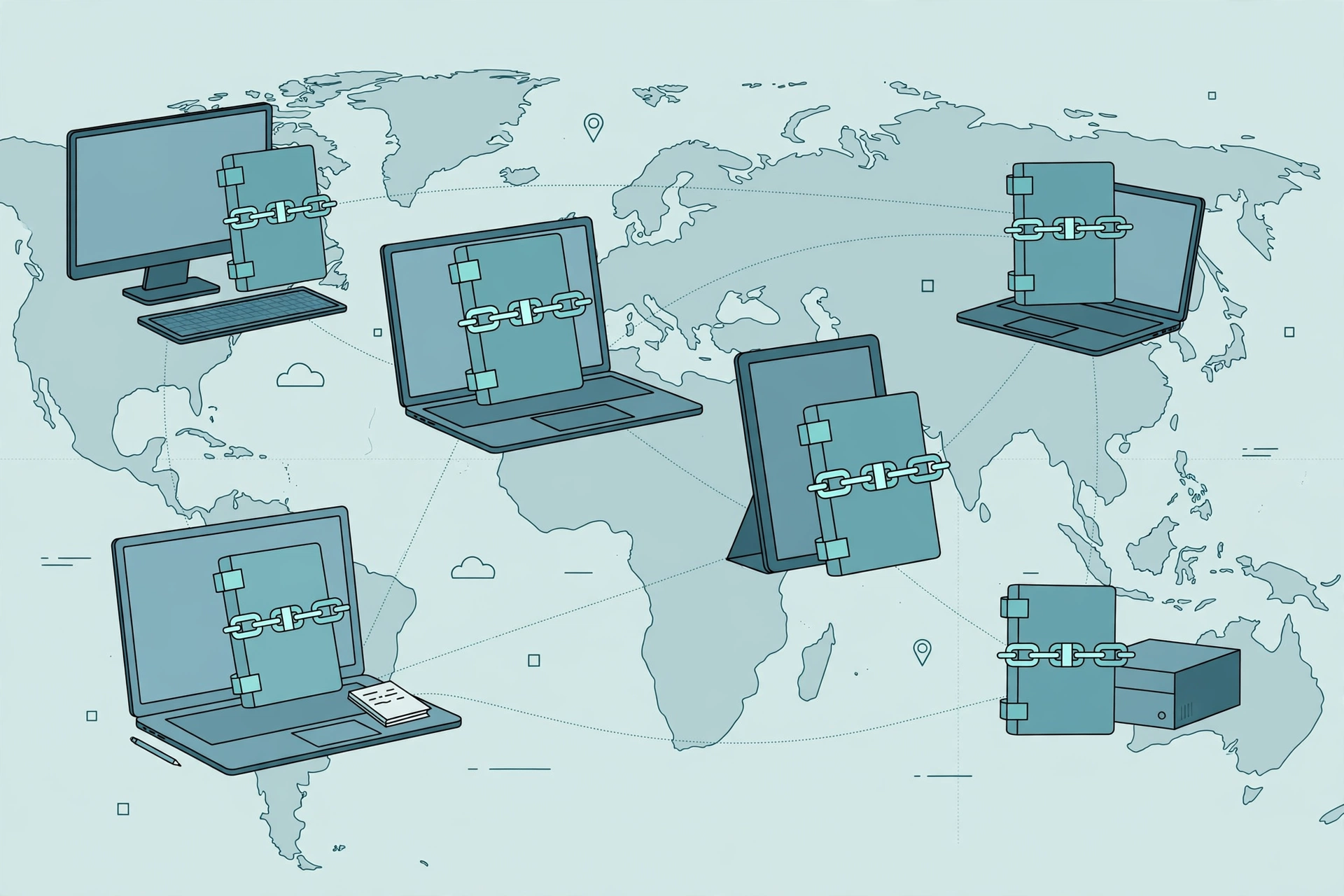
The short version: Decentralization means no single person, company or computer controls the record. Many independent participants each hold a copy of the ledger and check new entries against the same rules. One participant can fail, leave or misbehave, and the record still stands.
You’ll see the word on almost every crypto project page. Sometimes it describes how a network really runs. Sometimes it’s just a label on a homepage. The difference matters, and you can learn to spot it.
New to the basics? Start with our pillar guide to what a blockchain is, then come back here. This page takes one word from that guide — decentralization — and pulls it apart properly.
What does decentralization mean in a blockchain?
Decentralization means control and copies are spread across many independent participants instead of sitting with one operator. Each participant, called a node, holds the ledger, checks new blocks against shared rules and can reject entries that break those rules. No single node can rewrite history or stop the network on its own.
Picture a shared notebook. In a normal bank setup, one office holds the notebook. You ask that office what your balance is, and you trust its answer. If the office closes, loses the book or edits a page, you have a problem you can’t fix yourself.
Now picture thousands of people holding identical copies of the same notebook. New pages get added only when the copies agree the page follows the rules. One person scribbles on their copy? The other copies expose it. One person goes home sick? The book carries on without them.
That’s the shift. Trust moves from one keeper to a set of rules that many keepers enforce together. The Bitcoin whitepaper, published in 2008, built its cash system on exactly this idea: a peer-to-peer network where participants reach agreement without a central authority in the middle.

Is decentralization all or nothing?
No. Decentralization is a spectrum, not a switch. A network sits further along it when more independent people run nodes, when no small group can change the rules alone, and when joining doesn’t need anyone’s permission. It slides back when a few operators, one software team or one hosting provider quietly holds most of the power.
This is where marketing and reality part ways. A project can use a blockchain and still be tightly controlled. Ask three plain questions:
- Who can run a node? Anyone with ordinary hardware, or only approved partners?
- Who can change the rules? A broad set of participants, or one company with an admin key?
- What happens if the founding team disappears? Does the network keep running, or does everything stop with it?
The answers tell you more than any badge on a website. Ethereum’s own documentation makes the node point concrete: running a node lets you verify data yourself instead of trusting someone else’s copy, and the network gets stronger as more independent nodes join. You can read how that works in Ethereum’s nodes and clients documentation.
What does decentralization actually change for you?
Three things change in daily use. First, there’s no single point of failure. Second, records are harder to censor or quietly edit. Third, you can check the ledger yourself instead of taking a company’s word for it. None of that comes free — the costs show up as slower updates and harder coordination, covered below.
No single point of failure
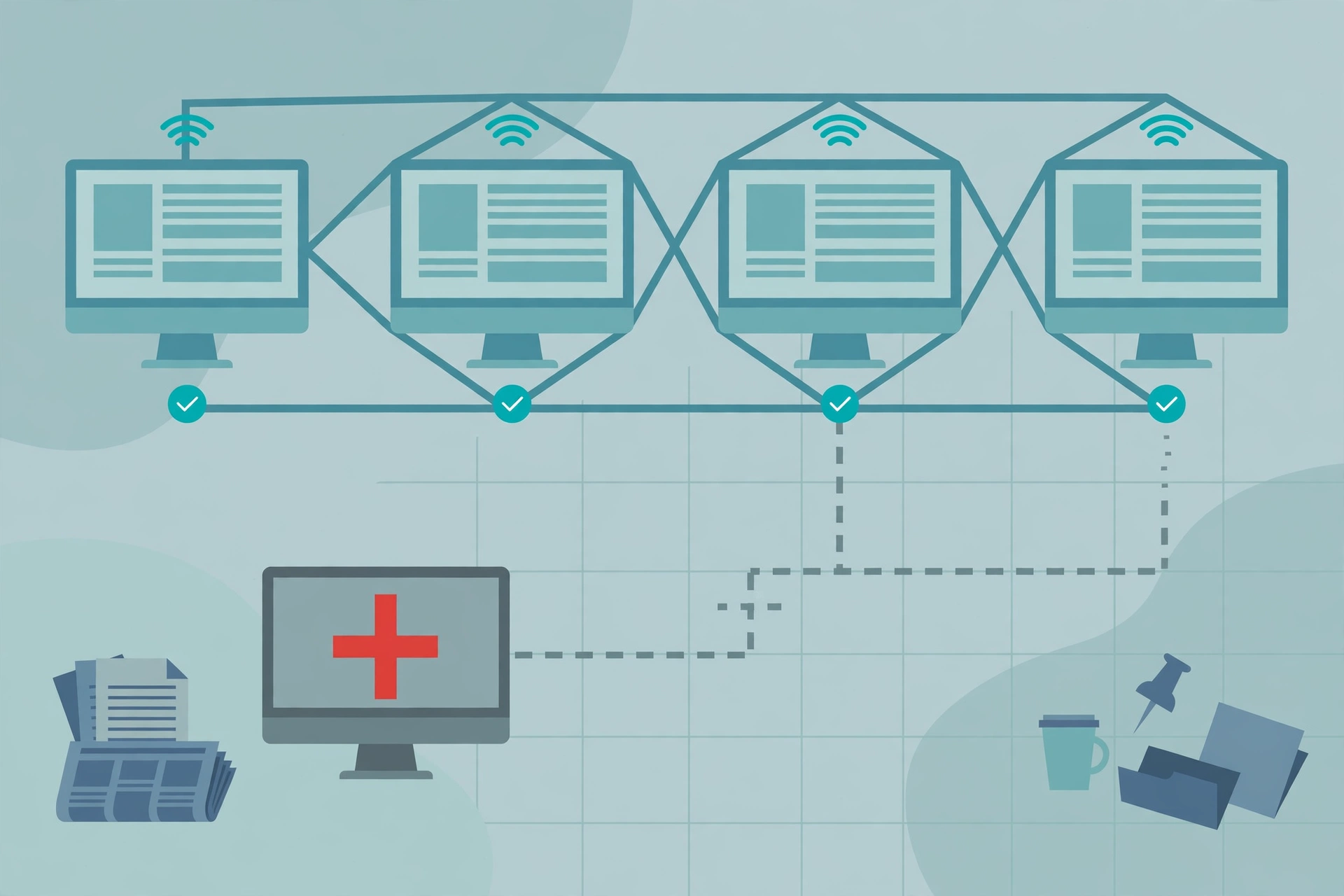
A service run from one office stops when that office stops. A network spread across many independent nodes doesn’t work that way. Individual computers go offline every day on large public networks. Blocks keep arriving because the remaining nodes still hold the full record and still follow the same rules.
Harder to censor, harder to rewrite
To block a valid entry on a spread-out network, you’d need to persuade or overpower a large share of independent operators at once. Same story for rewriting an old block. As our walk-through of how a blockchain works shows, changing an old block breaks its link to every block after it — and your altered copy stops matching everyone else’s. One operator can’t do that quietly.
You can verify instead of trusting
Here’s the part people skip. On a public network, you don’t have to believe a balance or a transfer happened just because a website says so. You can run a node, or check a public explorer, and read the record directly. Ethereum’s introduction to Web3 frames this as a move toward systems where users hold and verify their own data rather than relying on a platform’s copy — see ethereum.org’s Web3 explainer for that framing in its own words.
What does decentralization cost?
Plenty, if we’re honest. Agreement among strangers takes time, so a decentralized network usually confirms entries more slowly than one company’s database. Coordination is messy too. Changing the rules means getting many independent operators to move together, and sometimes they don’t — the network can split into two versions, each with its own copy of history.
There’s a support cost as well. A central operator can reverse a mistake, reset a password and answer the phone. A decentralized network often can’t. Send funds to a wrong address on a public chain and there’s usually no help desk that can undo it. The same design that stops a company from freezing your entry also stops anyone from fixing your error.
| Question | Centralized system | Decentralized network |
|---|---|---|
| Who holds the record? | One operator | Many independent nodes, each with a copy |
| Who can change the rules? | The operator, on its own | Participants together; no single party decides |
| What if the operator fails? | The service can stop entirely | The network continues on the remaining nodes |
| Can an entry be blocked or edited? | Yes, by the operator | Only if a large share of operators agrees or is overpowered |
| Can a mistake be reversed? | Often, by asking the operator | Usually not; entries are final once accepted |
| How fast is it? | Fast; one database decides | Slower; many parties must agree |
How is this different from Bitcoin itself?
Decentralization describes how control is spread. Bitcoin is one specific network built to spread control that way. Plenty of confusion comes from mixing the method with its first famous example. Our comparison of blockchain vs Bitcoin pulls the two apart in full. Keep it simple here: decentralization is a property a system can have in degrees. Bitcoin is one system that aims for a high degree of it.
One last warning, and it’s a practical one. Decentralized doesn’t mean safe, honest or well built. It describes who holds power over the record — nothing more. A poorly written program stays poorly written even when thousands of nodes run it faithfully. Judge the record-keeping and the project as two separate questions, because they are.
Frequently asked questions
What is decentralization in simple words?
It means nobody’s in sole charge. Many independent computers hold the same record and check new entries against shared rules, so no single person or company can change the record, block valid entries or shut the system down on their own.
Why does decentralization matter in crypto?
It removes the single keeper you would otherwise have to trust. The record survives individual failures, valid entries are harder to block, and anyone can verify the ledger directly instead of relying on one company’s version of it.
Is every blockchain decentralized?
No. Private and permissioned blockchains limit who can read, write or validate, and one organization may control them. Public networks such as Bitcoin and Ethereum let anyone run a node. The label depends on who holds power in practice, not on the word blockchain itself.
What is the downside of decentralization?
Speed and support. Reaching agreement across many independent parties is slower than asking one database, rule changes need broad coordination, and mistakes usually can’t be reversed by a help desk because there is no central operator to reverse them.
This article was created with AI assistance and reviewed by our editorial team before publishing.
Sources
- Bitcoin whitepaper, published in 2008 (bitcoin.org)
- Ethereum's nodes and clients documentation (ethereum.org)
- ethereum.org's Web3 explainer (ethereum.org)